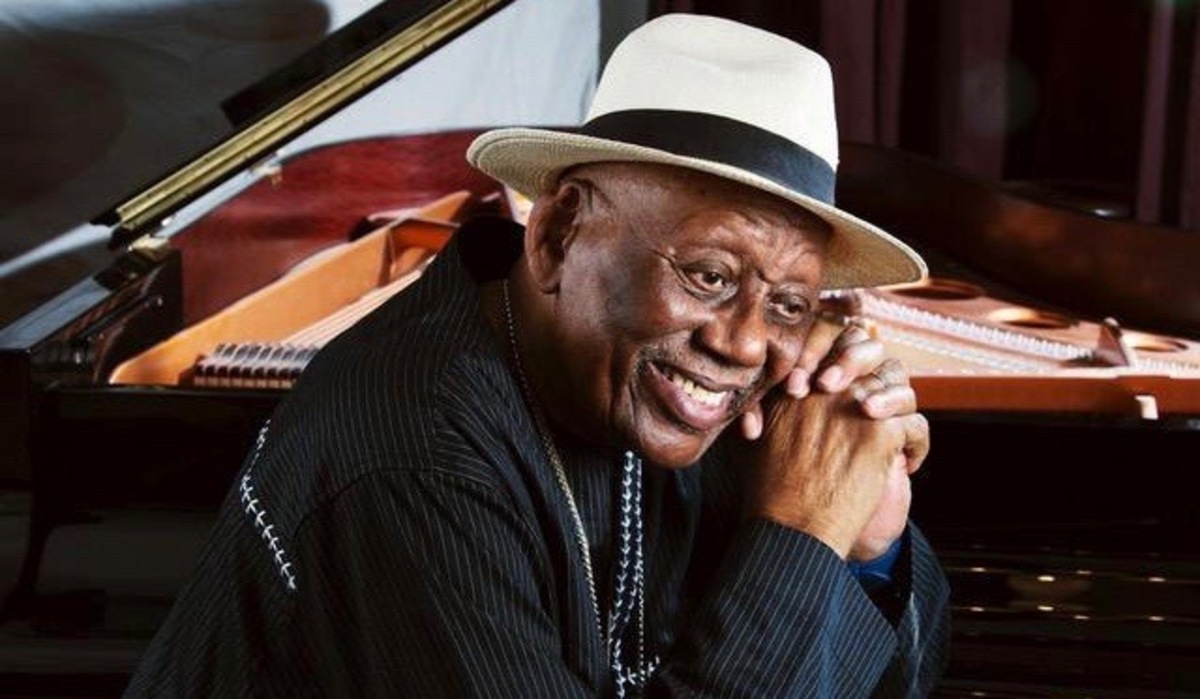
Randy Weston
Randy Weston (April 6, 1926 – September 1, 2018) was an American jazz pianist and composer, whose creativity was inspired by his ancestral African connection.
Weston's piano style owed much to Duke Ellington and Thelonious Monk, whom he cited in a 2018 video as among pianists he counted as influences, as well as Count Basie, Nat King Cole and Earl Hines. Beginning in the 1950s, Weston worked often with trombonist and arranger Melba Liston.
Described as "America's African Musical Ambassador", he said: "What I do I do because it's about teaching and informing everyone about our most natural cultural phenomenon. It's really about Africa and her music."
Biography
Early life
Randolph Edward Weston was born in 1926 to Vivian (née Moore) and Frank Weston and was raised in Brooklyn, New York, where his father owned a restaurant. His mother was from Virginia and his father was of Jamaican-Panamanian descent, a staunch Garveyite, who passed self-reliant values to his son. Weston studied classical piano as a child and took dance lessons. He graduated from Boys High School in Bedford-Stuyvesant, where he had been sent by his father because of the school's reputation for high standards. Weston took piano lessons from someone known as Professor Atwell who, unlike his former piano teacher Mrs Lucy Chapman, allowed him to play songs outside the classical music repertoire.
After serving in the U.S. Army during World War II, Weston ran a restaurant that was frequented by many jazz musicians. Among his piano heroes are Count Basie, Nat King Cole, Art Tatum , Duke Ellington, and his cousin Wynton Kelly. But Thelonious Monk made the biggest impact.
Early career: 1940s–50s
In the late 1940s Weston began performing with Bullmoose Jackson, Frank Culley and Eddie "Cleanhead" Vinson. He worked with Kenny Dorham in 1953 and in 1954 with Cecil Payne, before forming his own trio and quartet and releasing his debut recording as a leader in 1954, Cole Porter in a Modern Mood. He was voted New Star Pianist in Down Beat magazine's International Critics' Poll of 1955. Several fine albums followed, with the best being Little Niles near the end of that decade. Melba Liston provided excellent arrangements for a sextet playing several of Weston's best compositions: the title track, "Earth Birth", "Babe's Blues", and others.
1960s–70s
In the 1960s, Weston's music prominently incorporated African elements, as shown on the large-scale suite Uhuru Afrika (1960, with the participation of poet Langston Hughes) and Highlife (full title: Music from the New African Nations featuring the Highlife), the latter recorded in 1963, two years after Weston traveled for the first time to Africa, as part of a U.S. cultural delegation to Lagos, Nigeria. On both these albums he teamed up with the arranger Melba Liston. Uhuru Afrika, or Freedom Africa, is considered a historic landmark album that celebrates several new African countries obtaining their Independence.
In addition, during these years his band often featured the tenor saxophonist Booker Ervin. Weston covered the Nigerian Bobby Benson's piece "Niger Mambo", which included Caribbean and jazz elements within a Highlife style, and has recorded this number many times throughout his career.
In 1967 Weston traveled throughout Africa with a U.S. cultural delegation. The last stop of the tour was Morocco, where he decided to settle, running his African Rhythms Club in Tangier for five years, from 1967 to 1972. He said in a 2015 interview: "We had everything in there from Chicago blues singers to singers from the Congo.... The whole idea was to trace African people wherever we are and what we do with music."
In 1972 he produced Blue Moses for the CTI Records, a best-selling record on which he plays electric keyboard. As he explained in a July 2018 interview, "We were still living in Tangier, so my son and I came from Tangier to do the recording, but when I got there, Creed Taylor said his formula is electric piano. I was not happy with that, but it was my only hit record. People loved it." In the summer of 1975, he played at the Festival of Tabarka in Tunisia, North Africa (later known as the Tabarka Jazz Festival), accompanied by his son Azzedin Weston on percussion, with other notable acts including Dizzy Gillespie.
Later career
For a long stretch Weston recorded infrequently on smaller record labels. He also made a two-CD recording The Spirits of Our Ancestors(recorded 1991, released 1992), which featured arrangements by his long-time collaborator Melba Liston. The album contained new, expanded versions of many of his well-known pieces and featured an ensemble including some African musicians, with guests such as Dizzy Gillespie and Pharoah Sanders also contributing. The music director was saxophonist Talib Kibwe (also known as T. K. Blue), who continues in that role to the present day. The Spirits of Our Ancestors has been described as "one of the most imaginative explorations of 'world jazz' ever recorded."
Weston produced a series of albums in a variety of formats: solo, trio, mid-sized groups, and collaborations with the Gnawa musicians of Morocco. His most popular compositions include "Hi-Fly", which he has said was inspired by his experience of being 6' 8" and looking down at the ground, "Little Niles", named for his son, later known as Azzedin, "African Sunrise", "Blue Moses", "The Healers", and "Berkshire Blues". They have frequently been recorded by other prominent musicians, including Houston Person, Booker Ervin, and others.
In 2002 Weston performed with bassist James Lewis for the inauguration of the Bibliotheca Alexandrina in Alexandria, Egypt. During the same year he performed with Gnawa musicians at Canterbury Cathedral at the invitation of the Archbishop of Canterbury. Weston also played at the Kamigamo Shrine in Japan in 2005.
On June 21, 2009, he participated in a memorial at the Jazz Gallery in New York for Ghanaian drummer Kofi Ghanaba (formerly known as Guy Warren), whose composition "Love, the Mystery of..." Weston used as his theme for some 40 years.
In 2013, Sunnyside released Weston's album The Roots of the Blues, a duo session with tenor saxophonist Billy Harper. On November 17, 2014, as part of the London Jazz Festival, Weston played a duo concert with Harper at the Queen Elizabeth Hall. Kevin Le Gendre in his review said the two musicians reached "the kind of advanced conversational intimacy only master players achieve."
In 2015 Weston was artist-in-residence at The New School in New York, participating in a lecture series, performing, and mentoring students.
Weston celebrated his 90th birthday in 2016 with a concert at Carnegie Hall, among other activities, and continued thereafter to tour and speak internationally. He performed at the Gnawa Festival in Morocco in April 2016, took part in the Spoleto Festival in Charleston, SC, on June 2, and was among the opening acts at the 50th Montreux Jazz Festival. In July 2016 he was a keynote speaker at the 32nd World Conference of the International Society for Music Education in Glasgow.
An African Nubian Suite (2017) is a recording of a sold-out concert at the Institute of African American Affairs of New York University on April 8, 2012, Easter Sunday, with Cecil Bridgewater, Robert Trowers, Howard Johnson, T. K. Blue, Billy Harper, Alex Blake, Lewis Nash, Candido, Ayodele Maakheru, Lhoussine Bouhamidy, Saliou Souso, Martin Kwaku Obeng, Min Xiao-Fen, Tanpani Demda Cissoko, Neil Clarke and Ayanda Clarke, and the late poet Jayne Cortez. Describing it as an "epic work", the Black Grooves reviewer wrote that The African Nubian Suite "traces the history of the human race through music, with a narration by inspirational speaker Wayne B. Chandler, and introductions and stories by Weston in his role as griot.... Stressing the unity of humankind, Weston incorporates music that 'stretches across millennia'—from the Nubian region along the Nile Delta, to the holy city of Touba in Senegal, to China's Shang dynasty, as well as African folk music and African American blues.... In these troubling times when our nation is divided by politics, race and religion, Weston uses The African Nubian Suite as a vehicle to remind us of our common heritage: 'We all come from the same place – we all come from Africa.' As eloquently stated by Robin D.G. Kelley in the liner notes: 'There are no superior or inferior races, no hierarchies of culture, no barbarians at the gate. Instead, Africa—its music, land, people, spirituality—tie us all together as a planet.'"
Weston's last release, the double-CD set Sound (2018), was a recording of a solo piano concert that took place at the Hotel Montreux Palace, Switzerland, on July 17 and 18, 2001.
Randy Weston died at his home in Brooklyn on the morning of September 1, 2018.
Personal life
Weston's first marriage, to Mildred Mosley, ended in divorce. His son Azzedin having predeceased him, Weston was survived by his wife Fatoumata Mbengue-Weston, whom he met in 1994; three daughters, Cheryl, Pamela and Kim; seven grandchildren; six great-grandchildren; and one great-great-grandchild.
Autobiography
In October 2010, Duke University Press published African Rhythms: The Autobiography of Randy Weston, "composed by Randy Weston, arranged by Willard Jenkins". It was hailed as "an important addition to the jazz historiography and a long anticipated read for fans of this giant of African American music, aka jazz." Reviewer Larry Reni Thomas wrote: "Randy Weston’s long-anticipated, much-talked-about, consciousness-raising, African-centered autobiography, African Rhythms, is a serious breath of fresh air and is a much-needed antidote in this world of mediocre musicians, and men. He takes the reader on a wonderful, exciting journey from America to Africa and back with the ease of a person who loved every minute of it. The book is hard to put down and is an engaging, pleasing literary work that is worthy of being required reading in any history or literature school course."
Archives
In 2015–16, Weston's archives were acquired by the Jazz Research Initiative in collaboration with the Hutchins Center, Loeb Music Library, the Harvard College Library, and the Dean of the Faculty of Arts and Sciences. The Randy Weston Collection comprises hundreds of manuscripts, scores, videos, films, photographs, and more than 1,000 tape recordings, and among its highlights are correspondence with Langston Hughes and Alvin Ailey; photographs with Dizzy Gillespie, Pharoah Sanders, Muhammad Ali, and Cornel West; and records of Weston's African Rhythms Club in Tangier, Morocco, from 1967 to 1972.
Awards and honors
- 1997: Order of Arts and Letters, France
- 1999: Swing Journal Award, Japan
- 2000: Black Star Award, Arts Critics and Reviewers Association of Ghana
- 2001: NEA Jazz Master
- 2006: Honorary degree, Brooklyn College, City University of New York
- 2009: Giants of Jazz concert in his honor with Monty Alexander, Geri Allen, Cyrus Chestnut, Barry Harris, Mulgrew Miller and Billy Taylor.
- 2011: Guggenheim Fellowship award.
- 2011: Honored by King Mohammed VI of Morocco for "lifelong engagement with Morocco and deep commitment to bringing Morocco's Gnaoua music tradition to the attention of the Western world"
- 2011: Honored by Congressional Black Caucus Foundation at the Jazz Issue Forum and Concert during the 40th Annual Legislative Conference
- 2012: Honorary degree of Doctor of Music from Colby College
- 2013: Honorary degree, New England Conservatory of Music
- 2014: Doris Duke Artist Award
- 2014: JJA Jazz Award, Trio or Duo of the Year: Randy Weston - Billy Harper
- 2015: JJA Jazz Award, Lifetime Achievement in Jazz
- 2016: Malcolm X Black Unity award, National Association of Kawaida Organizations (NAKO) with the International African Arts Festival (IAAF)
- 2016: DownBeat Hall of Fame.
- 2016: United States Artists Fellowship Award
- 2017: National Jazz Museum in Harlem Legends Award
Discography
As leader
- 1954: Cole Porter in a Modern Mood (Riverside) - 10-inch LP
- 1955: The Randy Weston Trio (Riverside) - 10-inch LP
- 1955: Get Happy with the Randy Weston Trio (Riverside)
- 1956: With These Hands... (Riverside)
- 1955-56: Trio and Solo (Riverside) - includes all tracks on The Randy Weston Trio
- 1956: Jazz à la Bohemia (Riverside)
- 1956: The Modern Art of Jazz by Randy Weston (Dawn) - also released as How High the Moon (Biograph)
- 1957: Piano á la Mode (Jubilee)
- 1958: New Faces at Newport (MetroJazz)
- 1959: Little Niles (United Artists)
- 1959: Destry Rides Again (United Artists)
- 1959: Live at the Five Spot (United Artists)
- 1960: Uhuru Afrika (Roulette)
- 1963: Highlife (Colpix)
- 1964: Randy (Bakton) - later released as African Cookbook (Atlantic) in 1972
- 1965: Berkshire Blues (Freedom [1977])
- 1964-65: Blues (Trip)
- 1966: Monterey '66 (Verve)
- 1969: African Cookbook (Polydor)
- 1969: Niles Littlebig (Polydor)
- 1972: Blue Moses (CTI)
- 1973: Tanjah (Polydor)
- 1974: Carnival (Freedom)
- 1974: Informal Solo Piano (Hi-Fly)
- 1975: Blues to Africa (Freedom)
- 1975: African Nite (Owl)
- 1975: African Rhythms (Chant du Monde)
- 1976: Randy Weston Meets Himself (Pausa)
- 1976: Perspective (Denon)
- 1978: Rhythms-Sounds Piano (Cora)
- 1984: Blue (Arch)
- 1987: The Healers (Black Saint) - with David Murray
- 1989: Portraits of Thelonious Monk: Well You Needn't (Verve)
- 1989: Portraits of Duke Ellington: Caravan (Verve)
- 1989: Self Portraits: The Last Day (Verve)
- 1991: The Spirits of Our Ancestors (Verve)
- 1992: Marrakech in the Cool of the Evening (Verve/Gitanes)
- 1992: The Splendid Master Gnawa Musicians of Morocco (Verve/Gitanes)
- 1993: Volcano Blues (Verve/Gitanes)
- 1995: Saga (Verve)
- 1997: Earth Birth [featuring Montreal String Orchestra] (Verve)
- 1998: Khepera (Verve)
- 1999: Spirit! The Power of Music (Arkadia Jazz)
- 2002: Ancient Future (Mutable)
- 2004: Nuit Africa (Enja)
- 2006: Zep Tepi (Random Chance)
- 2009: The Storyteller (Motéma)
- 2013: The Roots of the Blues (Sunnyside)
- 2017: The African Nubian Suite (African Rhythms)
- 2018: Sound — Solo Piano (African Rhythms)
As sideman
With Roy Brooks
- Duet in Detroit (Enja, 1984 [1993])
With Charles Mingus
- Charles Mingus and Friends in Concert (Columbia, 1972)
https://en.wikipedia.org/wiki/Randy_Weston