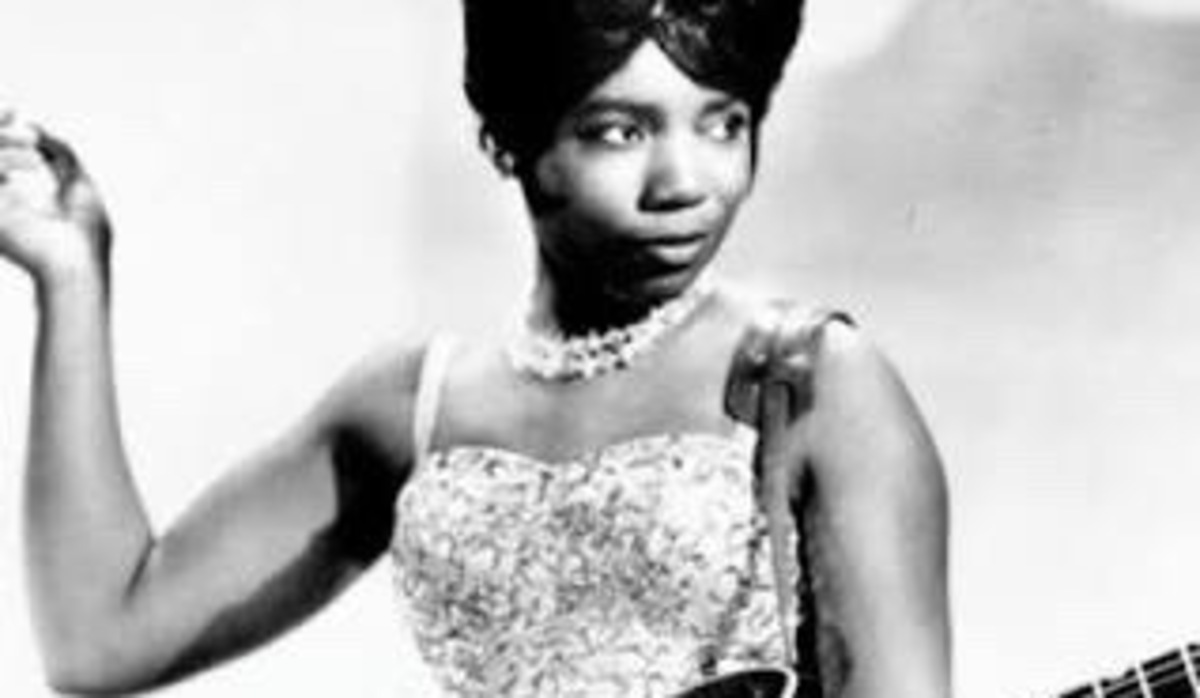
Norma-Jean 'The Duchess' Wofford
Norma-Jean Wofford (Circa 1942 – 30 April 2005; Pittsburgh, Pennsylvania), better known as The Duchess, was an American rhythm guitarist and vocalist celebrated for her highly influential tenure with rock and roll pioneer Bo Diddley.
Emerging as a visual and musical icon during the early 1962 to 1966 era, she established herself as one of the most prominent female instrumentalists in a heavily male-dominated industry. Known for her impeccable rhythm work, striking skintight stage clothes, and unique custom instrumentation, she provided a powerful foundation for Diddley’s signature beats. Her contributions extended beyond her musical output, as she remains a legendary figure in early rock and roll history whose stage presence and technical precision broke significant gender barriers.
Early Life
Born and raised in Pittsburgh, Pennsylvania, Wofford spent her formative years developing a deep appreciation for the vibrant rhythm and blues scene that shaped the region. While specific details surrounding her formal education and early family background remain sparse in public records, her musical foundations were strongly anchored in the guitar techniques of the era.
She spent her youth honing her foundational skills before being befriended by Bo Diddley in the late 1950s, who took an active interest in teaching her his specialised electric guitar sound and complex rhythm structures. This rigorous informal training prepared her to seamlessly step into a professional touring environment when the opportunity arose.
Career
Wofford officially joined Bo Diddley's band in 1962, replacing his pioneering original guitarist Peggy Jones, who was famously known as Lady Bo. To manage the disappointment of fans following Jones's departure, Diddley hired Wofford, bestowed upon her the aristocratic title of The Duchess, and strategically fabricated a myth that she was his sister to ensure male admirers treated her with appropriate respect on the road.
Beyond her exceptional performance on her signature rectangular Gretsch Jupiter Thunderbird guitar, she served as a deeply trusted road manager and confidante, completely managing the tour money as Diddley’s personal "bank" whilst travelling.
During her four-year commercial peak, she performed as a backing vocalist alongside Gloria Morgan and Lily "Bee Bee" Jamieson in a trio known as the Bo-ettes, and her image graced the covers of several high-profile albums, including Bo Diddley & Company, Bo Diddley's Beach Party, Hey! Good Lookin', 500% More Man, and The Originator. She also achieved a major cinematic milestone by appearing with the band in the iconic 1966 concert film The Big T.N.T. Show, performing tracks such as "Hey! Bo Diddley" and "Bo Diddley", before choosing to step away from the music industry entirely at the height of her commercial success.
Personal Life
In 1966, Wofford transitioned away from show business to focus on her family life, marrying and adopting the legal name Norma-Jean Richardson. She subsequently relocated to Florida, where she dedicated her time to raising her children and intentionally living a quiet, private life far removed from the public spotlight. Her enduring legacy resides in her status as a pioneering woman in rock music who challenged industry norms without sacrificing her autonomy.
On 30 April 2005, she passed away at the age of 63 in Fontana, California, leaving behind a profound historical impact on generations of subsequent female rock, blues, and alternative instrumentalists.
Prior to her passing, Wofford made a rare and deeply meaningful public reappearance in July 2004 when she surprised Bo Diddley by attending one of his concerts at the Fender Visitor Centre in Corona, California. Diddley later expressed immense and intense gratitude for the unexpected reunion, affectionately calling her his first sidekick and stating how profoundly glad he was that they had been afforded the chance to share that final moment together.
http://bit.ly/3JoZJnK