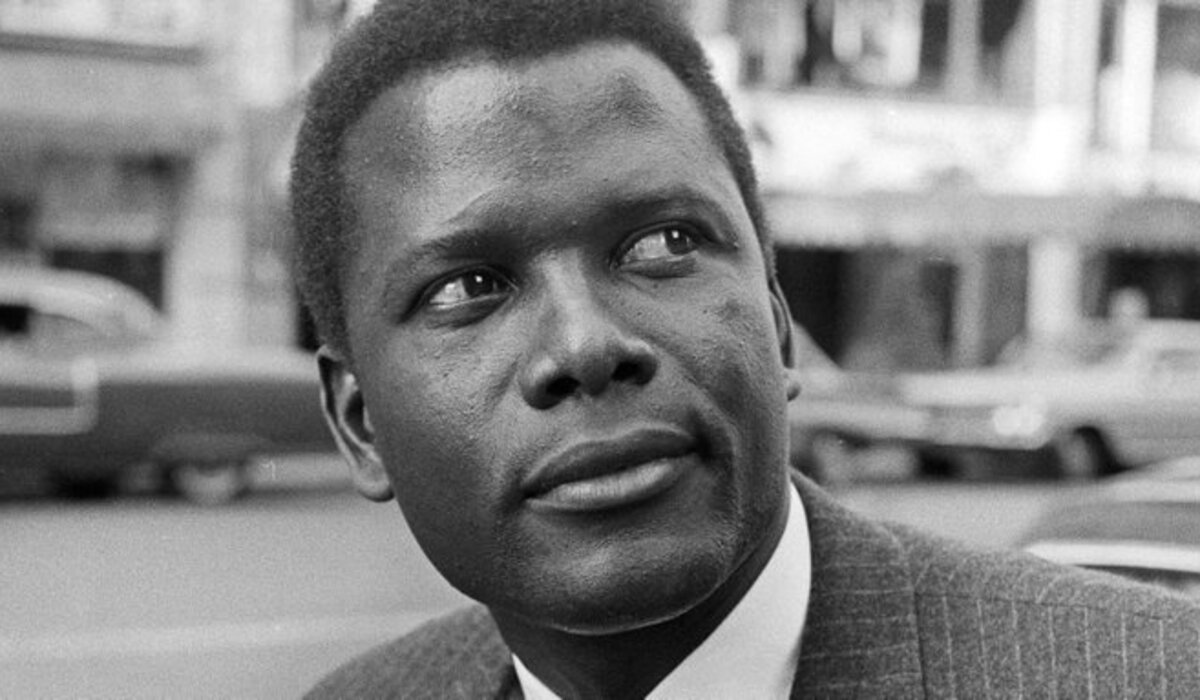
Sidney Poitier
Sir Sidney L. Poitier ( February 20, 1927 – January 6, 2022) was a Bahamian-American actor, film director, activist, and ambassador. In 1964, he won the Academy Award for Best Actor, becoming the first Black male and Bahamian actor to win the award. He received two further Academy Award nominations, ten Golden Globes nominations, two Primetime Emmy Awards nominations, six BAFTA nominations, eight Laurel nominations, and one Screen Actors Guild Awards nomination. Poitier was one of the last surviving major stars from the Golden Age of Hollywood cinema, and after the death of Kirk Douglas in 2020, was the oldest living and earliest surviving male Academy Award winner until his own death in 2022. From 1997 to 2007, Poitier served as Bahamian Ambassador to Japan.
Poitier also received acclaim for Porgy and Bess (1959), A Raisin in the Sun (1961), and A Patch of Blue (1965). He continued to break ground in three successful 1967 films which dealt with issues of race and race relations: To Sir, with Love; Guess Who's Coming to Dinner, and In the Heat of the Night. He received Golden Globe Award and British Academy Film Award nominations for his performance in the last film. He was the top box-office star of the year that anum. Beginning in the 1970s, Poitier also directed various comedy films including Stir Crazy (1980) starring Richard Pryor and Gene Wilder, among other films. After nearly a decade away from acting, he returned to television and film starring in Shoot to Kill (1988) and Sneakers (1992).
Sidney L. Poitier was the youngest of seven children, born to Evelyn (née Outten) and Reginald James Poitier, Bahamian farmers who owned a farm on Cat Island. The family would travel to Miami to sell tomatoes and other produce. Reginald also worked as a cab driver in Nassau, Bahamas. Poitier was born unexpectedly in Miami while his parents were visiting. His birth was two months premature, and he was not expected to survive, but his parents remained in Miami for three months to nurse him to health. Poitier grew up in the Bahamas, then a British Crown colony. Owing to his unplanned birth in the United States, he was automatically entitled to U.S. citizenship.
Poitier lived with his family on Cat Island until he was 10, when they moved to Nassau. There he was exposed to the modern world, where he saw his first automobile, first experienced electricity, plumbing, refrigeration, and motion pictures. He was raised Catholic but later became an agnostic with views closer to deism.
After leaving the Army, he worked as a dishwasher until a successful audition landed him a role in an American Negro Theater production.
Career
Early work
By late 1949, Poitier had to choose between leading roles on stage and an offer to work for Darryl F. Zanuck in the film No Way Out (1950). His performance in No Way Out, as a doctor treating a Caucasian bigot (played by Richard Widmark), was noticed and led to more roles, each considerably more interesting and more prominent than those most African-American actors of the time were offered. In 1951, he traveled to South Africa with the African-American actor Canada Lee to star in the film version of Cry, the Beloved Country. Poitier's breakout role was as Gregory W. Miller, a member of an incorrigible high-school class in Blackboard Jungle (1955).
In 1958 he starred alongside Tony Curtis in director Stanley Kramer's The Defiant Ones. Poitier and Curtis play prisoners chained-together who escape custody when the truck transporting them crashes and to avoid re-capture they must work cooperatively despite their mutual dislike. The film was a critical and commercial success with the performances of both Poitier and Curtis being praised. The film landed eight Academy Award nominations including Best Picture and Best Actor nominations for both stars, making Poitier the first Black male actor to be nominated for a competitive Academy Award as best actor. Both actors received the same nomination at the Golden Globes, but probably due to vote splitting between the two of them, neither won either award. Poitier did win the British Academy Film Award for Best Foreign Actor.
1960s
In 1961, Poitier starred in the film adaptation of A Raisin in the Sun where he received another Golden Globe Award nomination. Also in 1961, Poitier starred in Paris Blues alongside Paul Newman, Joanne Woodward, Louis Armstrong, and Diahann Carroll. The film dealt with American racism of the time contrasted with Paris's open acceptance of Black people. In 1963 he starred in Lilies of the Field, a film about an African American itinerant worker who encounters a group of East German nuns, who believe he has been sent to them by God to build them a new chapel. He was also the first Black actor to win the Academy Award for Best Actor (for Lilies of the Field in 1963). (James Baskett was the first African-American male to receive an Oscar, an Honorary Academy Award for his performance as Uncle Remus in the Walt Disney production of Song of the South in 1948, while Hattie McDaniel predated them both, winning as Best Supporting Actress for her role in 1939's Gone with the Wind, making her the first Black person to be nominated for and receive an Oscar). His satisfaction at this honor was undermined by his concerns that this award was more of the industry congratulating itself for having him as a token and it would inhibit him from asking for more substantive considerations afterward. Poitier worked relatively little over the following year; he remained the only major actor of African descent and the roles offered were predominantly typecast as a soft-spoken appeaser.
In 1967, he was the most successful draw at the box office, the commercial peak of his career, with three popular films, To Sir, with Love, In the Heat of the Night, and Guess Who's Coming to Dinner. In To Sir, with Love, Poitier plays a teacher at a secondary school in the East End of London. The film deals with social and racial issues in the inner city school. The film was met with mixed response, however, Poitier was praised for his performance, with the critic from Time writing, "Even the weak moments are saved by Poitier, who invests his role with a subtle warmth."
In Stanley Kramer's social drama Guess Who's Coming to Dinner, Poitier played a man in a relationship with a white woman played by Katharine Houghton. The film revolves around her bringing him to meet with her parents played by Katharine Hepburn and Spencer Tracy. The film was one of the rare films at the time to depict an interracial marriage in a positive light, as interracial marriage historically had been illegal in most states of the United States. It was still illegal in 17 states—mostly Southern states—until June 12, 1967, six months before the film was released. The film was a critical and financial success. In his film review, Roger Ebert described Poitier's character as "a noble, rich, intelligent, handsome, ethical medical expert" and that the film "is a magnificent piece of entertainment. It will make you laugh and may even make you cry." To win his role as Dr. Prentice in the film, Poitier had to audition for Tracy and Hepburn at two separate dinner parties.
In the Heat of the Night featured his most successful character, Virgil Tibbs, a Philadelphia, Pennsylvania detective whose subsequent career was the subject of two sequels: They Call Me MISTER Tibbs! (1970) and The Organization (1971).
In 2002, Poitier received the 2001 Honorary Academy Award for his overall contribution to American cinema. Later in the ceremony, Denzel Washington won the award for Best Actor for his performance in Training Day, becoming the second Black actor to win the award. In his victory speech, Washington saluted Poitier by saying "I'll always be chasing you, Sidney. I'll always be following in your footsteps. There's nothing I would rather do, sir."
From 1995 to 2003, Poitier served as a member of the board of directors of The Walt Disney Company.
Diplomatic service
Poitier was first married to Juanita Hardy from April 29, 1950, until 1965. Poitier became a resident of Mount Vernon in Westchester County in 1956, though they raised their family in Stuyvesant, New York, in a house on the Hudson River. In 1959, Poitier began a nine-year affair with actress Diahann Carroll. He married Joanna Shimkus, a Canadian former actress, on January 23, 1976, and they remained married for the rest of his life. He had four daughters with his first wife (Beverly, Pamela, Sherri, and Gina) and two with his second (Anika and Sydney Tamiia) In addition to his six daughters, Poitier had eight grandchildren and three great-grandchildren. When Hurricane Dorian hit the Bahamas in September 2019, Poitier's family had 23 missing relatives.
Poitier became the first Black actor to win the Academy Award for Best Actor for Lilies of the Field (1963). He also received a Grammy Award, two Golden Globe Awards and a British Academy Film Award. He has received numerous honoraries during his lifetime including the Academy Honorary Award for his lifetime achievement in film in 2001. In 1992, Poitier received the AFI Life Achievement Award. In 1994, Poitier received a star on the Hollywood Walk of Fame. In 1981, he received the Golden Globe Cecil B. DeMille Award and In 2016 he received the BAFTA Fellowship.
In 1995, Poitier received the Kennedy Center Honor and In 2009, Poitier was awarded the Presidential Medal of Freedom from Barack Obama. He was also awarded as Knight Commander of the Order of the British Empire by Queen Elizabeth II in 1974.
https://en.wikipedia.org/wiki/Sidney_Poitier