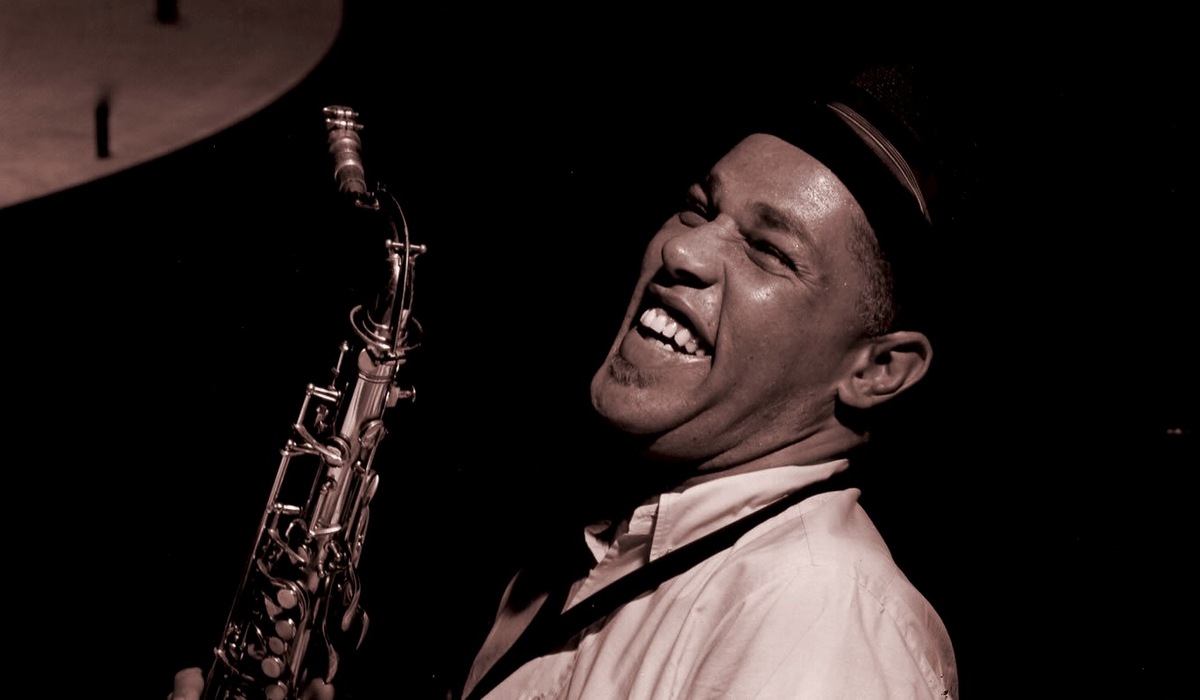
Dexter Gordon
Dexter Gordon (February 27, 1923 – April 25, 1990) was an American jazz tenor saxophonist. He was among the earliest tenor players to adapt the bebop musical language of people such as Charlie Parker, Dizzy Gillespie, and Bud Powell to the instrument. Gordon's height was 6 feet 6 inches (198 cm), so he was also known as "Long Tall Dexter" and "Sophisticated Giant". His studio and live performance career spanned over 40 years.
Gordon's sound was commonly characterized as being "large" and spacious and he had a tendency to play behind the beat. He was famous for humorously inserting musical quotes into his solos. One of his major influences was Lester Young. Gordon, in turn, was an early influence on John Coltrane and Sonny Rollins. Rollins and Coltrane then influenced Gordon's playing as he explored hard bop and modal playing during the 1960s.
Gordon was known for his genial and humorous stage presence. He was an advocate of playing to communicate with the audience. One of his idiosyncratic rituals was to recite lyrics from each ballad before playing it.
A photograph by Herman Leonard of Gordon taking a smoke break at the Royal Roost in 1948 is one of the iconic images in jazz photography. Cigarettes were a recurring theme on covers of Gordon's albums.
Gordon was nominated for an Academy Award for Best Actor in a Leading Role for his performance in the Bertrand Tavernier film Round Midnight (Warner Bros, 1986), and he won a Grammy for Best Jazz Instrumental Performance, Soloist, for the soundtrack album The Other Side of Round Midnight (Blue Note Records, 1986). He also had a cameo role in the 1990 movie, Awakenings.
Life and career
Early life
Dexter Keith Gordon was born on February 27, 1923 in Los Angeles, California. His father, Dr. Frank Gordon, was one of the first African American doctors in Los Angeles who arrived in 1918 after graduating from Howard Medical School in Washington, D.C. Among his patients were Duke Ellington and Lionel Hampton. Dexter's mother, Gwendolyn Baker, was the daughter of Captain Edward Baker, one of the five African American Medal of Honor recipients in the Spanish–American War. Gordon played clarinet from the age of 13, before switching to saxophone (initially alto, then tenor) at 15. While still at school, he played in bands with such contemporaries as Chico Hamilton and Buddy Collette.
Between December 1940 and 1943, Gordon was a member of Lionel Hampton's band, playing in a saxophone section alongside Illinois Jacquet and Marshal Royal. During 1944 he was featured in the Fletcher Henderson band, followed by the Louis Armstrong band, before joining Billy Eckstine. The 1942–44 musicians' strike curtailed the recording of the Hampton, Henderson, and Armstrong bands; however, they were recorded on V-Discs produced by the Army for broadcast and distribution among overseas troops. In 1943 he was featured, alongside Harry "Sweets" Edison, in recordings under Nat Cole for a small label not affected by the strike.
Bebop era recordings
By late 1944, Gordon was resident in New York and a featured soloist in the Billy Eckstine big band (If That's The Way You Feel, I Want To Talk About You, Blowin' the Blues Away, Opus X, I'll Wait And Pray, The Real Thing Happened To Me, Lonesome Lover Blues, I Love the Rhythm in a Riff,), and during early 1945 he was featured on recordings by Dizzy Gillespie (Blue 'n' Boogie, Groovin' High) and Sir Charles Thompson (Takin' Off, If I Had You, 20th Century Blues, The Street Beat). By late 1945 he was recording under his own name for the Savoy label. His Savoy recordings during 1945-46 included Blow Mr. Dexter, Dexter's Deck, Dexter's Minor Mad, Long Tall Dexter, Dexter Rides Again, I Can't Escape From You, and Dexter Digs In. He returned in Los Angeles in late 1946 and in 1947 was leading sessions for Ross Russell's Dial label (Mischievous Lady, Lullaby in Rhythm, The Chase, Iridescence, It's the Talk of the Town, Bikini, A Ghost of a Chance, Sweet and Lovely). After his return to Los Angeles, he became known for his saxophone duels with fellow tenorman Wardell Gray, which were a popular concert attraction documented in recordings made between 1947 and 1952 (The Hunt, Move, The Chase, The Steeplechase). The Hunt gained literary fame from its mention in Jack Kerouac's On The Road, which also contains descriptions of wild tenormen jamming in Los Angeles. Cherokee, Byas a Drink, and Disorder at the Border are other live recordings of the Gray/Gordon duo from the same concert as The Hunt. In December 1947, Gordon recorded again with the Savoy label (Settin' the Pace, So Easy, Dexter's Riff, Dextrose, Dexter's Mood, Index, Dextivity, Wee Dot, Lion Roars). Through the mid-to-late 1940s he continued to work as a sideman on sessions led by Russell Jacquet, Benny Carter, Ben Webster, Ralph Burns, Jimmy Rushing, Helen Humes, Gerry Mulligan, Wynonie Harris, Leo Parker, and Tadd Dameron.
The 1950s
During the 1950s, Gordon's recorded output and live appearances declined as heroin addiction and legal troubles took their toll. Gordon made a concert appearance with Wardell Gray in February 1952 (The Chase, The Steeplechase, Take the A Train, Robbins Nest, Stardust) and appeared as a sideman in a session led by Gray in June 1952 (The Rubiyat, Jungle Jungle Jump, Citizen's Bop, My Kinda Love) After an incarceration at Chino Prison during 1953-55, he recorded the albums Daddy Plays the Horn and Dexter Blows Hot and Cool in 1955 and played as a sideman on the Stan Levey album, This Time the Drum's on Me. The latter part of the decade saw him in and out of prison until his final release from Folsom Prison in 1959. He was one of the initial sax players for the Onzy Matthews big band in 1959, along with Curtis Amy. Gordon continued to champion Matthews' band after he left Los Angeles for New York, but left for Europe before getting a chance to record with that band. He recorded The Resurgence of Dexter Gordon in 1960. His recordings from the mid-1950s onward document a meander into a smooth West Coast style that lacked the impact of his bebop era recordings or his subsequent Blue Note recordings.
The decade saw Gordon's first entry into the world of drama. He appeared as a member (uncredited) of Art Hazzard's band in the 1950 film Young Man with a Horn. He appeared in an uncredited and overdubbed role as a member of a prison band in the movie Unchained, filmed inside Chino. Gordon was a saxophonist performing Freddie Redd's music for the Los Angeles production of Jack Gelber's play The Connection in 1960, replacing Jackie McLean. He contributed two compositions, Ernie's Tune and I Want More to the score and later recorded them for his album Dexter Calling.
New York renaissance
Gordon signed to Blue Note Records in 1961. He initially commuted from Los Angeles to New York to record, but took up residence when he regained the cabaret card that allowed him to perform where alcohol was served. The Jazz Gallery hosted his first New York performance in twelve years. The Blue Note association was to produce a steady flow of albums for several years, some of which gained iconic status. His New York renaissance was marked by Doin' Allright, Dexter Calling..., Go!, and A Swingin' Affair. The first two were recorded over three days in May 1961 with Freddie Hubbard, Horace Parlan, Kenny Drew, Paul Chambers, George Tucker, Al Harewood, and Philly Joe Jones. The last two were recorded in August 1962, with a rhythm section that featured Blue Note regulars Sonny Clark, Butch Warren and Billy Higgins. Of the two Go! was an expressed favorite. The albums showed his assimilation of the hard bop and modal styles that had developed during his years on the west coast, and the influence of John Coltrane and Sonny Rollins, whom he had influenced before. The stay in New York turned out to be short lived, as Gordon got offers for engagements in England, then Europe, that resulted in a fourteen-year stay. Soon after recording A Swingin' Affair, he was gone.
Years in Europe
Over the next 14 years in Europe, living mainly in Paris and Copenhagen, Gordon played regularly with fellow expatriates or visiting players, such as Bud Powell, Ben Webster, Freddie Hubbard, Bobby Hutcherson, Kenny Drew, Horace Parlan and Billy Higgins. Blue Note's German-born Francis Wolff supervised Gordon's later sessions for the label on his visits to Europe. The pairing of Gordon with Drew turned out to be one of the classic matchups between a horn player and a pianist, much like Miles Davis with Red Garland or John Coltrane with McCoy Tyner.
From this period come Our Man in Paris, One Flight Up, Gettin' Around, and Clubhouse. Our Man in Paris was a Blue Note session recorded in Paris in 1963 with a quartet including pianist Powell, drummer Kenny Clarke, and French bassist Pierre Michelot. One Flight Up, recorded in Paris in 1964 with trumpeter Donald Byrd, pianist Kenny Drew, drummer Art Taylor, and Danish bassist Niels-Henning Ørsted Pedersen, features an extended solo by Gordon on the track "Tanya".
Gordon also visited the US occasionally for further recording dates. Gettin' Around was recorded for Blue Note during a visit in May 1965, as was the album Clubhouse which remained unreleased until 1979.
Gordon found Europe in the 1960s a much easier place to live, saying that he experienced less racism and greater respect for jazz musicians. He also stated that on his visits to the US in the late 1960s and early 1970s, he found the political and social strife disturbing. While in Copenhagen, Gordon and Drew's trio appeared onscreen in Ole Ege's theatrically released hardcore pornographic film Pornografi (1971), for which they composed and performed the score.
He switched from Blue Note to Prestige Records (1965–73) but stayed very much in the hard-bop idiom, making classic bop albums like The Tower of Power! and More Power! (1969) with James Moody, Barry Harris, Buster Williams, and Albert "Tootie" Heath; The Panther!(1970) with Tommy Flanagan, Larry Ridley, and Alan Dawson; The Jumpin' Blues (1970) with Wynton Kelly, Sam Jones, and Roy Brooks; The Chase!(1970) with Gene Ammons, Jodie Christian, John Young, Cleveland Easton, Rufus Reid, Wilbur Campbell, Steve McCall, and Vi Redd; and Tangerine (1972) with Thad Jones, Freddie Hubbard, and Hank Jones. Some of the Prestige albums were recorded during visits back to North America while he was still living in Europe; others were made in Europe, including live sets from the Montreux Jazz Festival.
In addition to the recordings Gordon did under his major label contracts, live recordings by European labels and live video from his European period are available. The Danish label Steeplechase released live dates from his mid-1960s tenure at the Montmartre Jazzhus. The video was released under the Jazz Icons series.
Less well known than the Blue Note albums, but of similar quality, are the albums he recorded during the 1970s for the Danish label SteepleChase (Something Different, Bouncin' With Dex, Biting the Apple, The Apartment, Stable Mable, The Shadow of Your Smile and others). They again feature American sidemen, but also such Europeans as Spanish pianist Tete Montoliu and Niels-Henning Ørsted Pedersen.
Homecoming
Gordon finally returned to the United States for good in 1976. He appeared with Woody Shaw, Ronnie Mathews, Stafford James, and Louis Hayes, for a gig at the Village Vanguard in New York that was dubbed his "homecoming." It was recorded and released by Columbia Records under that title. He noted: "There was so much love and elation; sometimes it was a little eerie at the Vanguard. After the last set they'd turn on the lights and nobody would move." In addition to the Homecoming album, a series of live albums was released by Blue Note from his stands at Keystone Corner in San Francisco during 1978 and 1979. They featured Gordon, George Cables, Rufus Reid, and Eddie Gladden. He recorded the studio albums Sophisticated Giant with an eleven piece big band in 1977 and Manhattan Symphonie with the Live at Keystone Corner crew in 1978. The sensation of Gordon's return, renewed promotion of the classic jazz catalogs of the Savoy and Blue Note record labels, and the continued efforts of Art Blakey through 1970s and early 1980s, have been credited with reviving interest in swinging, melodic, acoustically-based classic jazz sounds after the Fusion jazz era that saw an emphasis on electronic sounds and contemporary pop influences.
http://wikipedia.thetimetube.com/?lang=en&q=Dexter Gordon