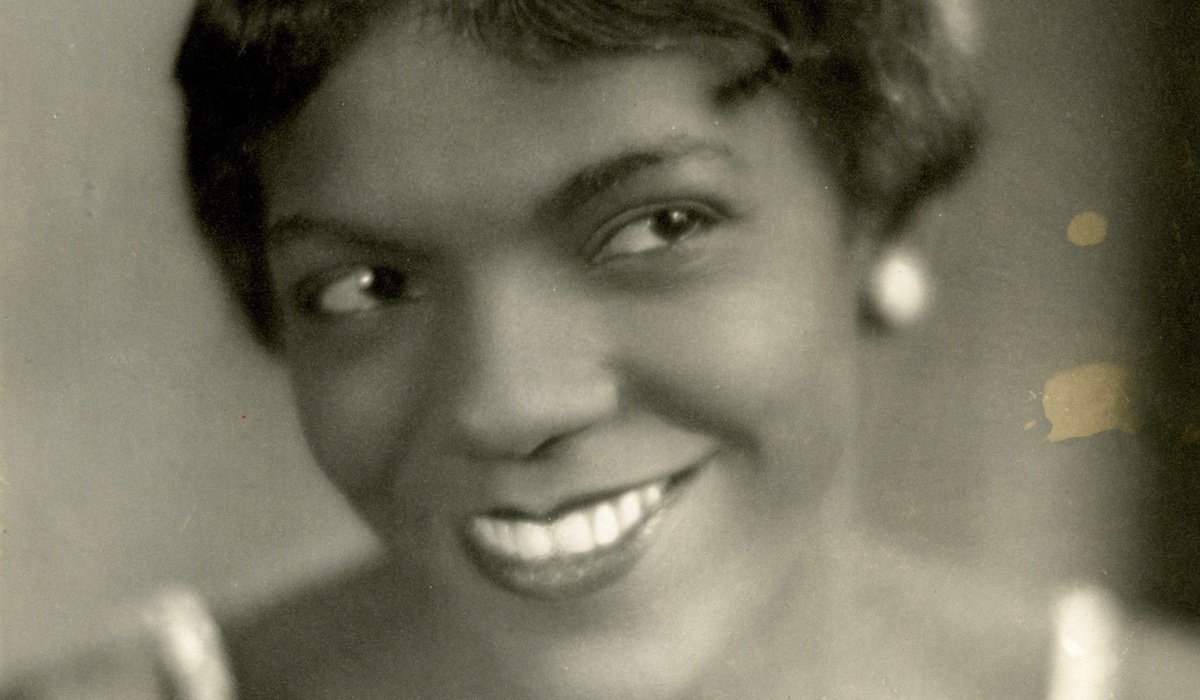
Ivie Anderson
Ivie Anderson (sometimes Ivy) (July 10, 1905 – December 28, 1949) was an American jazz singer. She enjoyed success during the 1930s, touring and recording with the band of Duke Ellington. Anderson retired from singing in 1942 (age 37) due to poor health, and she died 7 years later in 1949, at just 44 years old.
Personal life
Anderson was born in Gilroy, California. Although her mother's name is unknown, her father was Jobe Smith. Anderson lived at 724 E 52nd Place, Los Angeles, California, United States, North America, from 1930 to 1945, now part of the 52nd Place Historic District.
From 1914 to 1918 (age 9 to 13), Anderson attended St. Mary’s Convent and studied voice. At Gilroy grammar and high school, she joined glee club and choral society. She also studied voice under Sara Ritt while in Nannie H. Burroughs Institution in Washington, D.C.
Although specific dates of events in Anderson's life were unknown, she opened Ivie's Chicken Shack in Los Angeles, alongside Marque Neal, after they had married, but sold the business when they divorced. She had a second marriage with Walter Collins but no children.
In 1949, after suffering for years from asthma, Ivie Anderson died in Los Angeles, California. Although her earliest obituary was dated as December 27, 1949, later sources state her date of death as December 28, 1949. She is interred in Angelus-Rosedale Cemetery.
Career
Shuffle Along
Anderson’s singing career officially started around 1921 when she performed in Los Angeles, California. From 1922 to 1923, she was brought to New York City by joining a pioneering African-American musical revenue Shuffle Along. By 1924 and 1925, she had already performed in various locations such as Cuba, the Cotton Club in New York City, and Los Angeles with the bands of Paul Howard, Curtis Mosby, and Sonny Clay. In 1928, she sang in Australia with Clay’s band and starred in Frank Sebastian's Cotton Club in Los Angeles in April. Soon after, she finally began touring in the United States as a solo singer.
Duke Ellington's band
From 1930 to early 1931, Anderson spent 20 weeks at the Grand Terrace in Chicago, Illinois, with pianist Earl Hines’s band. In February 1931, she officially joined Duke Ellington’s orchestra band. Anderson’s singing career for the next dozen years was mainly based on touring in various areas within the United States alongside Ellington’s band. She sang in Ellington’s first European performance in 1933.
Before Ellington signed Anderson, he had never had a regular vocalist. The records he made prior to 1931 with vocals were made up of Ellington's musicians, freelance vocalists, or vocalists supplied by the record company for the sessions. Manager Irving Mills also sang on a handful of sides.
Distinguished jazz critic Nat Hentoff described Anderson as:
"...easily the most sensitive and musical female vocalist Ellington ever had...She sang with a simplicity ... so artless that she is ... remarkably neglected in ... writings about jazz...She sang with a supple warmth and caressing beat that made her one of the unforgettable voices in Jazz...direct, completely unpretentious and ungimmicked."
Anderson was also very popular as an entertainer with Ellington, often receiving prominent billing on advertisements for Ellington's appearances in theatres, auditoriums, arenas, and ballrooms, wherever the Ellington band toured in the 1930s. She had become the band's scat singer, imitating instrumental sounds and various vocalizations. Later on, she even began singing lively pop tunes and ballads, which became her signature singing style. She was said to be one of Ellington's finest and most versatile singer after Swedish vocalist Alice Babs, who also sang in his band. Ellington wrote Music Is My Mistress (1973) with Anderson in mind.
When Anderson played in Ellington's musical Jump for Joy, the California Eagle wrote of her:
"Ivie can sing a song so that the audience get every word, and at the same time make cracks at Sonny Greer, tease Duke and wink at the boys in the front row. Wednesday night she went into a dance routine that would have slayed you."
Anderson's performance of "Stormy Weather" in the movie short Bundle of Blues (1933) was only eclipsed by the later and far better-known version sung by Lena Horne in Horne's later movie with that title (1943). Ellington's indifference towards vocalists changed with the hiring of Anderson, who was generally considered the best regular vocalist he ever employed. She also appeared as a singer in the Marx Brothers movie A Day at the Races (1937) and the same year in Hit Parade of 1937 (as Ivy Anderson). Due to chronic asthma, Anderson left Ellington's band in 1942.
Discography
Ellington songs featuring Anderson include:
1932
- "It Don't Mean a Thing (If It Ain't Got That Swing)" (Brunswick 6265) February 2, 1932
- "Delta Bound" (Columbia 37298) December 21, 1932 (not issued until the 1940s)
1933
- "I've Got the World on a String" (UK Columbia CB-625) February 15, 1933 (recorded in New York but only issued overseas)
- "Stormy Weather" 1933 quoted in Stuart Nicholson's book "Reminiscing in Tempo" page 131
- "Happy as the Day Is Long" (Brunswick 6571) May 9, 1933
- "Raisin' the Rent" (Brunswick 6571) May 9, 1933
- "Get Yourself a New Broom (and Sweep Your Blues Away)" (Brunswick 6607) May 9, 1933
- "I'm Satisfied" (Brunswick 6638) August 15, 1933
1934
- "Ebony Rhapsody" (Victor 24622) April 12, 1934
- "Troubled Waters" (Victor 24651) May 9, 1934
- "My Old Flame" (Victor 24651) May 9, 1934
1935
- "Let's Have a Jubilee" (unissued on 78) January 9, 1935
- "Cotton" (Brunswick 7525) August 19, 1935
- "Truckin'" (Brunswick 7514) August 19, 1935
1936
- "Dinah Lou" (unissued on 78) January 20, 1936
- "Isn't Love the Strangest Thing?" (Brunswick 7625) February 27, 1936
- "Love Is Like a Cigarette" (Brunswick 7627) February 28, 1936
- "Kissin' My Baby Goodnight" (Brunswick 7627) February 28, 1936
- "Oh Babe! Maybe Someday" (Brunswick 7667) February 28, 1936
- "Shoe Shine Boy" (Brunswick 7710) July 17, 1936
- "It Was a Sad Night in Harlem" (Brunswick 7710) July 17, 1936
1937
- "I've Got To Be a Rug Cutter" (Master MA-101) March 5, 1937
- "My Honey's Lovin' Arms" (as The Gotham Stompers) (Variety VA-629) March 25, 1937
- "Did Anyone Ever Tell You?" (as The Gotham Stompers) (Variety VA-541) March 25, 1937
- "Where Are You?" (as The Gotham Stompers) (Variety VA-541) March 25, 1937
(The Gotham Stompers session included members of Ellington's band plus members of Chick Webb's.)
- "There's a Lull in My Life" (Master MA-117) April 9, 1937
- "It's Swell of You" (Master MA-117) April 9, 1937
- "The Old Plantation" (as Ivie Anderson And Her Boys From Dixie) (Variety VA-591) April 22, 1937
- "All God's Chillun Got Rhythm" (as Ivie Anderson And Her Boys From Dixie) (Variety VA-591) June 8, 1937
- "Alabamy Home" (Master VA-137) June 8, 1937
1938
- "If You Were in My Place (What Would You Do?)" (Brunswick 8093) February 24, 1938
- "Scrounch" (Brunswick 8093) February 24, 1938
- "Carnival in Caroline" (Brunswick 8099) March 3, 1938
- "Swingtime in Honolulu" (Brunswick 8131) April 11, 1938
- "You Gave Me the Gate (and I'm Swingin')" (Brunswick 8169) June 7, 1938
- "Rose of the Rio Grande" (Brunswick 8186) June 7, 1938
- "When My Sugar Walks Down the Street" (Brunswick 8168) June 7, 1938
- "Watermelon Man" (Brunswick 8200) June 20, 1938
- "La De Doody Do" (Brunswick 8174) June 20, 1938
1939
- "In a Mizz" (Brunswick 8405) June 12, 1939
- "I'm Checkin' Out, Goo'm Bye" (Columbia 35208) June 12, 1939
- "A Lonely Co-ed" (Columbia 35240) June 12, 1939
- "You Can Count On Me" (Brunswick 8411) June 12, 1939
- "Killing Myself" (Columbia 35640) October 16, 1939
- "Your Love Has Faded" (Columbia 35640) October 16, 1939
1940
- "Solitude" (Columbia 35427) February 14, 1940
- "Stormy Weather" (Columbia 35556) February 14, 1940
- "Mood Indigo" (Columbia 35427) February 14, 1940
- "So Far, So Good" (Victor 26537) March 6, 1940
- "Me and You" (Victor 26598) March 15, 1940
- "At a Dixie Roadside Diner" (Victor 26719) July 22, 1940
- "Five O'Clock Whistle" (Victor 26748) September 15, 1940
1941
- "Chocolate Shake" (Victor 27531) June 26, 1941
- "I Got It Bad (and That Ain't Good)" (Victor 27531) June 26, 1941
- "Jump for Joy" (Victor LPV 517) July 2, 1941
- "Rocks in My Bed" (Victor 27639) September 26, 1941
1942
- "I Don't Mind" (Victor 20-1598) February 26, 1942
- "Hayfoot, Strawfoot" (Victor 20-1505) July 28, 1942
https://en.wikipedia.org/wiki/Ivie_Anderson